
Yamaha
Yamaha PX3 Power Amplifier
Compact 2U power with speaker processing built in
- 300 W x 2 at 8 Ω and 500 W x 2 at 4 Ω (1 kHz, non-clip, 20 ms burst)
- Power Boost mode combines both channels: 600 W x 1 at 8 Ω or 1,000 W x 1 at 4 Ω
- Onboard crossover, HPF/LPF, delay, limiter, 6-band PEQ and D-CONTOUR processing
- Config Wizard with presets for Yamaha passive speakers such as CBR and Club series
- XLR/TRS inputs; speakON, binding post and 1/4-inch outputs; 8 presets with USB backup
Taxes included.
Yamaha PX3 2-Channel Class-D Power Amplifier with DSP
The Yamaha PX3 is a two-channel, 2U rack-mount power amplifier built on a Class-D engine and fitted with its own speaker processing. Yamaha rates it at 300 W x 2 into 8 Ω and 500 W x 2 into 4 Ω, and it is the entry point of the PX range.
It suits rental companies, bands, venues, schools, places of worship and installers who drive passive speakers and want crossover, EQ, delay and limiting inside the amplifier rather than in separate outboard units. Basic and Advanced setup modes cater to both newcomers and experienced engineers.
Key Features
PX3 output power into 8, 4 and 2 Ω
Yamaha specifies the PX3 at 300 W x 2 into 8 Ω, 500 W x 2 into 4 Ω and 300 W x 2 into 2 Ω, all measured at 1 kHz, non-clip, 20 ms burst, both channels driven. These are the figures for the 220–240 V version sold in India. The wide load range lets you run a single pair of cabinets or several speakers in parallel.
Class-D engine on a single custom LSI
The amplifier engine concentrates its key functions into one custom LSI chip and uses PLL technology to control transfer characteristics in real time. The result is a light yet robust design: the PX3 weighs 6.9 kg and occupies 2U, cooled by two 16-step variable-speed fans with front-to-rear airflow.
Power Boost mode on the PX3 power amplifier
Power Boost mode combines both channels into one, delivering 600 W x 1 into 8 Ω or 1,000 W x 1 into 4 Ω (1 kHz, non-clip, 20 ms burst, both channels driven, 220–240 V version). It is useful for a single high-power-handling speaker or subwoofer, with the trade-off that only one output channel is available. Among the PX models, only the PX3 and PX5 offer this mode.
Amp Mode routing in 15 patterns
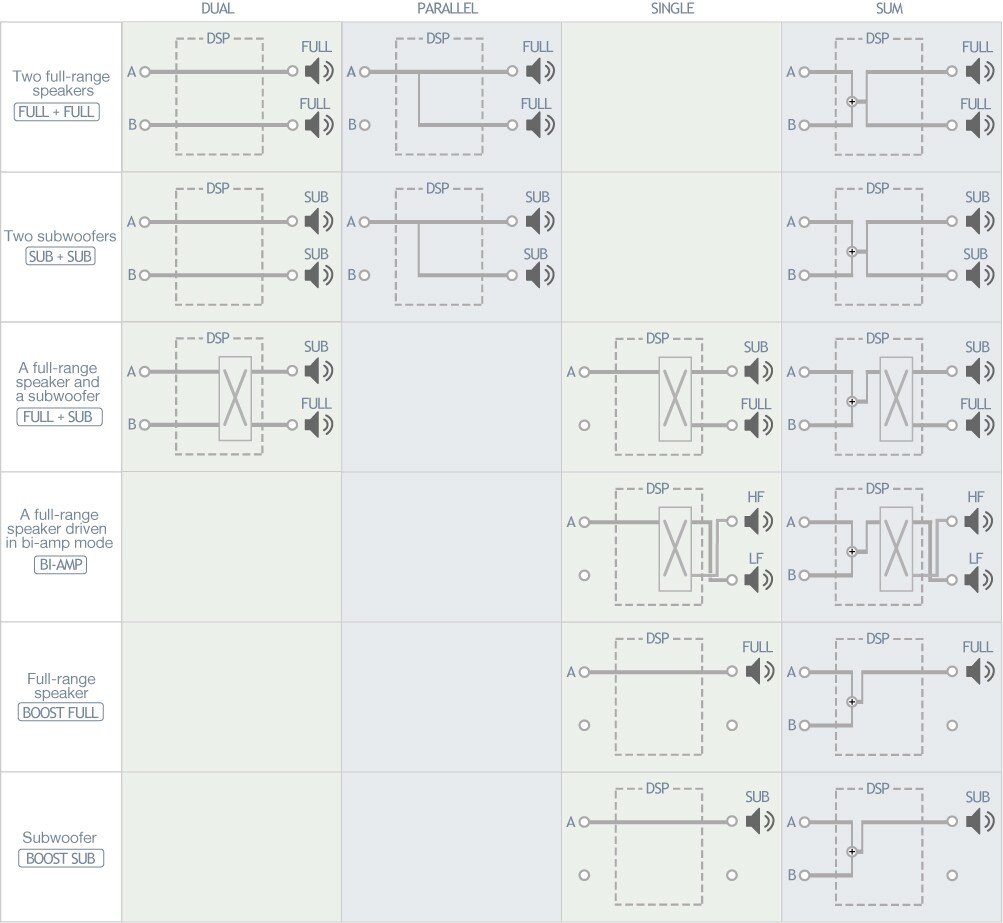
Amp Mode configures the amplifier by combining an input routing (Dual, Parallel, Single or SUM) with a speaker structure: FULL+FULL, SUB+SUB, FULL+SUB, Bi-Amp, Boost Full or Boost Sub. Yamaha lists 15 selectable patterns in total, so a two-top system, a sub-and-top pair or a bi-amped cabinet can be set up quickly.
Built-in speaker processing in the PX3
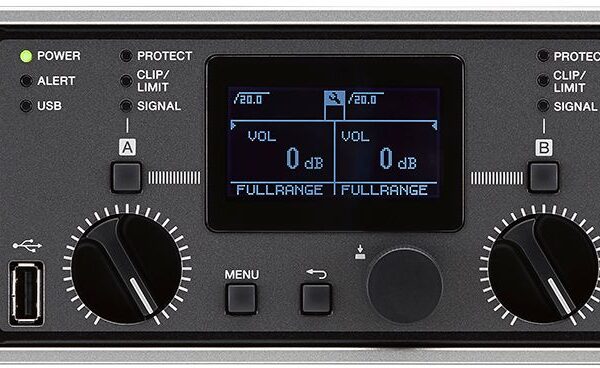
Each unit includes input summing, high- and low-pass filters adjustable from 20 Hz to 20 kHz with polarity control, delay of up to 74 ms and a speaker processor combining 6-band PEQ, limiter and delay. Yamaha's D-CONTOUR multi-band dynamic processing (FOH/Main or Monitor) keeps the sound clear and consistent, and analogue-in to speaker-out latency is 1.5 ms. Editing of the 6-band PEQ requires firmware V1.5 or later in Advanced mode.

Config Wizard and Yamaha speaker presets
A Basic mode guides less experienced users, while Advanced mode exposes input routing, input sensitivity, amp gain and speaker impedance. Config Wizard applies optimised filter and crossover settings, with presets tuned for Yamaha passive speakers including the CBR, Club, Installation and VXS/VXC series. Yamaha adds presets through firmware updates, such as V1.66, which added the CXR mk3 and CXS mk3 series.
Eight presets, USB transfer and panel lock
Eight user presets can be recalled instantly, saved to a USB thumb drive and shared with other PX amplifiers. The front USB port also handles speaker preset and firmware updates, and can export device and log data for troubleshooting. A panel lock prevents accidental changes once the system is tuned.
Professional inputs, outputs and road-ready build
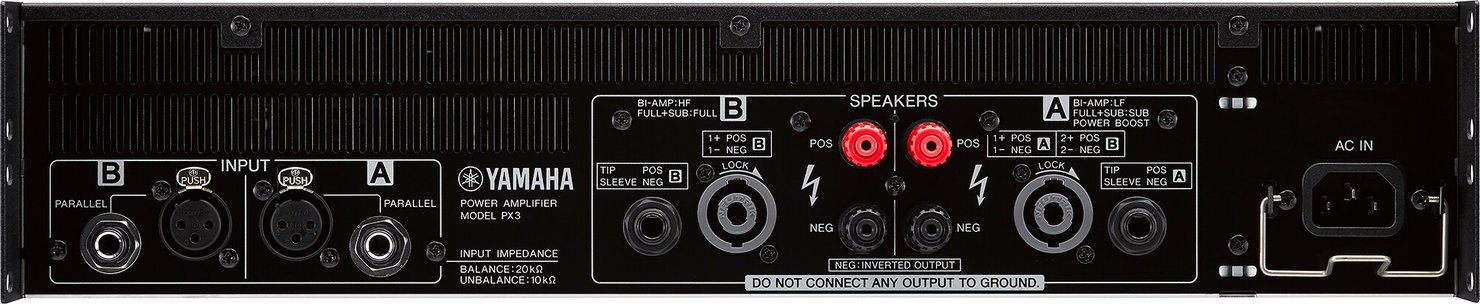
Each channel has an XLR and a 1/4-inch TRS input wired in parallel, accepting up to +24 dBu. Speaker outputs are provided on Neutrik speakON NL4, binding posts and 1/4-inch TS jacks, and the sturdy chassis with carrying handles is designed for regular touring.
Frequently Asked Questions
How does the PX3 compare with the other PX models sold on YMS?
All four PX models share the same 2U chassis, DSP, presets and connections; they differ in output power. Per Yamaha, at 8 Ω / 4 Ω (1 kHz, non-clip, 20 ms burst, both channels driven): PX3 300 W / 500 W x 2, PX5 500 W / 800 W x 2, PX8 800 W / 1,050 W x 2 and PX10 1,000 W / 1,200 W x 2. Only the PX3 and PX5 add Power Boost mode.
Does the PX3 have a bridge or Power Boost mode?
Yes. Power Boost mode combines both channels into one output: 600 W x 1 into 8 Ω or 1,000 W x 1 into 4 Ω for the 220–240 V version. You then have one channel instead of two.
What comes in the box?
Yamaha lists a USB cover, the Owner's Manual, a specification sheet and a 2.0 m AC cable. Speaker and signal cables are not included.
Which speakers can I use with it?
Any passive speakers whose impedance and power handling suit the PX3; Yamaha rates it down to 2 Ω. Config Wizard has factory presets for Yamaha passive series such as CBR (for example the CBR15), Club, Installation and VXS/VXC. For other speakers, such as the CHR series, check Yamaha's current preset list or set the filters, PEQ and limiter manually.
What mains power does it need in India?
Indian units run on 220–240 V, 50/60 Hz. Yamaha quotes power consumption of 160 W at 1/8 of maximum power (4 Ω, pink noise on all channels) and 55 W when idling at 4 Ω.
Do I need a mixer to use it?
Yes, a power amplifier needs a line-level source. Connect a mixer such as a Yamaha MG or DM3 series console to the balanced XLR or TRS inputs, which accept signals up to +24 dBu.
Why Buy from YMS?
- Authorised Yamaha Premium Retailer
- Genuine stock with full manufacturer warranty
- Demo units at our Bengaluru and Mangaluru stores
- Secure delivery across India
- Free domestic shipping on all orders
Specifications
Overview
| Model | Yamaha PX3 |
|---|---|
| Type | 2-channel power amplifier with DSP |
| Series | PX Series |
| Amplifier Class | Class D, balanced output circuit (BTL) |
| Rack Size | 2U |
Output Power (1 kHz, non-clip, 20 ms burst, both channels driven)
| 8 Ω | 300 W x 2 |
|---|---|
| 4 Ω | 500 W x 2 |
| 2 Ω | 300 W x 2 |
| 8 Ω, Power Boost mode | 600 W x 1 |
| 4 Ω, Power Boost mode | 1,000 W x 1 |
Performance
| Total Harmonic Distortion | 0.1% (1 kHz, 10 W); 0.3% (1 kHz, half power) |
|---|---|
| Frequency Response | ±1.0 dB (1 W, 8 Ω, 20 Hz to 20 kHz) |
| S/N Ratio | 100 dB (A-weighted, 8 Ω, gain setting +14 dBu) |
| Crosstalk | Less than -60 dB (half power, 8 Ω, 1 kHz, volume max, input 150 Ω shunt) |
| Voltage Gain / Sensitivity (8 Ω, volume max) | 32.0 dB / +4.1 dBu (gain setting 32 dB); 26.0 dB / +10.1 dBu (26 dB); 32.1 dB / +4 dBu (+4 dBu); 22.1 dB / +14 dBu (+14 dBu) |
| Voltage Gain / Sensitivity (8 Ω, volume max, Power Boost mode) | 35.0 dB / +4.1 dBu (gain setting 32 dB); 29.0 dB / +10.1 dBu (26 dB); 35.1 dB / +4 dBu (+4 dBu); 25.1 dB / +14 dBu (+14 dBu) |
| Maximum Input Voltage | +24 dBu |
| Input Impedance | 20 kΩ (balanced), 10 kΩ (unbalanced) |
Processing
| Sampling Frequency | 48 kHz (internal) |
|---|---|
| A/D and D/A Converters | 24-bit linear, 128x oversampling |
| Processors | Input summing; D-CONTOUR (FOH/Main, Monitor, Off); delay (0–74 ms); HPF/LPF (20 Hz–20 kHz cutoff, polarity control); speaker processor (6-band PEQ + limiter + delay) |
| Latency | 1.5 ms (analogue input to speakers) |
| Presets | 8 user amplifier presets; factory speaker presets for Yamaha passive speakers |
Inputs & Outputs
| Line Inputs | XLR-3-31 x 2, 1/4-inch TRS phone x 2 |
|---|---|
| Speaker Outputs | Neutrik speakON NL4 x 2, binding posts x 2 pairs, 1/4-inch TS phone x 2 |
| Other | USB 2.0 Type-A (female) for save/load, speaker preset and firmware updates; AC inlet x 1 with cord clamp |
| Indicators | Power, Alert, USB, Protect x 2, Clip/Limit x 2, Signal x 2; auto LED-off feature |
Protection
| Load Protection | Output mute at power on/off; over-voltage limiter, user-configurable by wattage and speaker preset; DC fault: power supply shutdown (not restored automatically) |
|---|---|
| Amplifier Protection | Thermal: output limiter then output mute (auto restore); over-current: output mute (auto restore); over-voltage and integrated power limit: output limiter (auto restore) |
| Power Supply Protection | Thermal: output limiter then power supply shutdown; over-voltage and over-current: power supply shutdown |
General
| Cooling | 2 x 16-step variable-speed fans, front-to-rear airflow |
|---|---|
| Power Requirements | 220–240 V, 50/60 Hz (India); 100 V and 120 V versions sold elsewhere |
| Power Consumption | 160 W (1/8 max power, 4 Ω, pink noise, all channels); 55 W (4 Ω, idling) |
| Dimensions (W x H x D) | 480 x 88 x 388 mm (18-7/8 x 3-7/16 x 15-2/8 in) |
| Net Weight | 6.9 kg (15.21 lb) |
| Operating Temperature | 0 °C to +40 °C |
| Storage Temperature | -20 °C to +60 °C |
Included Accessories
| In the Box | USB cover, Owner's Manual, specification sheet, AC cable (2.0 m) x 1 |
|---|
Specifications from Yamaha India's PX Series specs page (220–240 V model); subject to change by Yamaha.
Similar products
Yamaha PX8 Power Amplifier
MRP₹78,00030% OFFYMS Price₹54,599Yamaha PX10 Power Amplifier
MRP₹89,50030% OFFYMS Price₹62,649Yamaha PX5 Power Amplifier
MRP₹66,60030% OFFYMS Price₹46,619

Reviews
There are no reviews yet.