
Yamaha
Yamaha MGP24X 24-Channel Premium Analog Mixing Console
Premium analog - dual effects engines, six sends, matrix outs.
- 16 mic inputs with 48V phantom power and a 100 Hz high-pass filter per channel
- Six AUX sends plus two dedicated FX sends - effects never cost you a monitor mix
- Dual effects engines - REV-X reverb and SPX multi-effects running simultaneously
- Channel inserts on all 16 mono channels, two matrix outputs and a mono out
- Priority ducker and leveler for unattended installs, plus USB WAV/MP3 recording
Taxes included.
A Different Class of Desk from the MG
The MGP24X is not a bigger MG. It is Yamaha's premium analog console: 24 mixing channels with 16 mic inputs, six AUX sends plus two dedicated FX sends, four group buses, matrix outputs, a mono out, channel inserts on every mono channel, talkback, and two independent effects engines running at once — REV-X reverb and SPX multi-effects.
It is built for installed sound and larger production work: theatres, auditoria, houses of worship, banquet and conference venues, and rental companies. The features that matter there — inserts for outboard, matrix feeds for lobby and overflow zones, a priority ducker so a microphone automatically dips the background music without an operator — simply do not exist on the MG range.
At a Glance
What You Get
- 16 mic inputs, each with +48V phantom power and its own 100 Hz high-pass filter, on discrete Class-A D-PRE preamps. 24 line inputs in total (16 mono, 4 stereo).
- Six AUX sends plus two separate FX sends. The effects never eat into your monitor mixes — six independent foldback or zone feeds stay available at all times.
- Channel inserts on all 16 mono channels, for patching outboard compressors, gates or channel strips into the signal path.
- Two matrix outputs and a mono output — separate feeds for a lobby, an overflow room, a broadcast leg or a delay ring, mixed independently of front of house.
- Dual effects engines. FX1 is Yamaha's high-resolution REV-X reverb (Hall, Room, Plate — 8 programmes); FX2 is the SPX multi-effect processor (16 programmes) with editable parameters. Both run simultaneously.
- USB recording and playback direct to a USB storage device, in WAV or MP3, sourced from the Stereo Out or Matrix Out 1/2 — and playback routable to a hybrid channel or monitor out.
- Internal universal power supply, 100–240V, plus talkback mic input. 819 × 169 × 565 mm, 15.5 kg.
Three Things the MG Range Cannot Do
1. Priority Ducker
Nominate a microphone and it automatically pulls down the background music the moment someone speaks, then restores the level when they stop. No operator required — the reason this desk suits unmanned installs, conference rooms and hospitality venues.
2. The Stereo Hybrid Channel
A digitally controlled stereo channel sitting inside an analog console, with its own three-band mid-sweep EQ and onboard converters. It is where the ducker, the leveler and the USB playback live — analog-style knobs on the surface, DSP underneath.
3. X-pressive EQ
Yamaha's modelled vintage EQ curves — 8 kHz high shelf, sweepable 250 Hz–5 kHz mid, 125 Hz low shelf, ±15 dB — with very steep shelving derived from classic outboard modules. A different response from the standard MG EQ, not just more of it.
There is also a Leveler, an automatic gain-riding compressor for un-manned playback, and one-knob compressors with LED indicators so you can see compression engage on each channel.
MGP24X or MGP32X?
The two consoles are the same desk in two sizes. Everything that shapes the sound is identical — choose on input count and how much space you have.
| MGP24X (this console) | MGP32X | |
|---|---|---|
| Mixing channels | 24 — 16 mono + 4 stereo | 32 — 24 mono + 4 stereo |
| Mic inputs | 16 | 24 |
| Channel inserts | 16 | 24 |
| One-knob compressors | Channels 9–16 | Channels 9–24 |
| Sends, buses, matrix | Identical — 6 AUX + 2 FX sends, 4 group buses + stereo, 2 matrix out, 1 mono out | |
| Effects | Identical — REV-X (8 programmes) and SPX (16 programmes), both running at once | |
| Preamps & EQ | Identical — discrete Class-A D-PRE, X-pressive EQ, 100 Hz HPF per mic input | |
| Width | 819 mm | 1,027 mm |
| Weight | 15.5 kg | 19 kg |
FAQ
Q. How is this different from an MG20XU?
Substantially. The MG20XU has four AUX sends shared with its effects, no inserts, no matrix, no mono out, no talkback, one effects engine and no ducker. The MGP24X has six sends plus two separate FX sends, sixteen inserts, two matrix outputs, a mono out, talkback and two effects engines running together. They are aimed at different jobs.
Q. Can it record multitrack?
No. The USB port records a stereo pair to a USB storage device as WAV or MP3, taken from the Stereo Out or a Matrix Out — an archive of the event, not a session. For multitrack from a Yamaha mixer, look at the MGX12 or MGX16 digital consoles.
Q. Any catch with USB recording?
Yes, worth knowing: WAV recording has strict transfer-speed requirements and some USB flash drives will not keep up. Yamaha recommends a fast USB hard disk or SSD for WAV. MP3 recording works with ordinary USB sticks.
Q. What does the priority ducker need to work?
Nothing external. You assign the priority mic and the attenuation depth at the desk, and it operates automatically — which is why these consoles end up in venues where nobody is sitting at the board.
Q. Is it rack-mountable?
No — at 819 mm wide this is a table or flight-case console, not a rack unit. The internal universal power supply does make it straightforward to install permanently, with no external adapter to accommodate.
Why Buy from YMS?
YMS For Music is an authorised Yamaha Premium Retailer. Every console is genuine Yamaha stock with full manufacturer warranty, sold and supported by people who use these desks on real jobs.
For an install of this size, talk to us first — channel counts, matrix zoning and ducker setup are worth getting right before you buy. Demo units in Bengaluru and Mangaluru, secure delivery across India.
Specifications
Overview
| Model | Yamaha MGP24X |
|---|---|
| Type | 24-channel premium analog mixing console |
| Series | MGP Premium Series |
Channels & Buses
| Mixing Channels | 24 line inputs - 16 mono and 4 stereo |
|---|---|
| Mic Inputs | 16, each with +48V phantom power and 100 Hz 12 dB/oct HPF |
| Mic Preamps | Discrete Class-A D-PRE, inverted Darlington circuit |
| Channel Inserts | 16 |
| Stereo Return | 1 |
| AUX Sends | 6 |
| FX Sends | 2 |
| Group Buses | 4 GROUP buses + ST bus |
| Matrix Out | 2 |
| Mono Out | 1 |
| Talkback | Dedicated talkback mic input |
Processing
| EQ | X-pressive EQ, +/-15 dB max - mono: 8 kHz high shelving, 250 Hz-5 kHz sweepable mid, 125 Hz low shelving |
|---|---|
| Stereo Channel EQ | +/-15 dB max - 8 kHz shelving, 2.5 kHz peaking, 125 Hz shelving |
| High-Pass Filter | 100 Hz, 12 dB/oct |
| Compressor | 1-knob compressor with LED indicator, channels 9-16 |
| FX1 | REV-X reverb - 8 programs (Hall, Room, Plate), parameter control |
| FX2 | SPX multi-effects - 16 programs, parameter control |
| Hybrid Channel | Stereo Hybrid Channel with mid-sweep three-band EQ and onboard A/D and D/A conversion |
| Priority Ducker | Automatic level attenuation of a source when the priority mic is used |
| Leveler | Automatic level compensation for unattended playback |
Digital & Recording
| USB | USB device recording and playback |
|---|---|
| Record Format | WAV or MP3 |
| Record Source | Stereo Out, or Matrix Out 1 and 2 |
| Note | WAV recording has strict transfer-speed requirements - Yamaha recommends a fast USB hard disk or SSD; MP3 works with standard USB memory |
General
| Total Harmonic Distortion | 0.02% (20 Hz-20 kHz @ +14 dBu) |
|---|---|
| Frequency Response | +0.5 / -1.0 dB, 20 Hz-20 kHz |
| Equivalent Input Noise | -128 dBu |
| Residual Output Noise | -92 dBu |
| Crosstalk | -74 dB @ 1 kHz |
| Dimensions (W x H x D) | 819 x 169 x 565 mm |
| Net Weight | 15.5 kg |
| Power | Internal universal supply, AC 100-240V, 50/60 Hz |
| Power Consumption | 86 W max |
Not rack-mountable. Specifications from Yamaha official MGP series product data.
Similar products
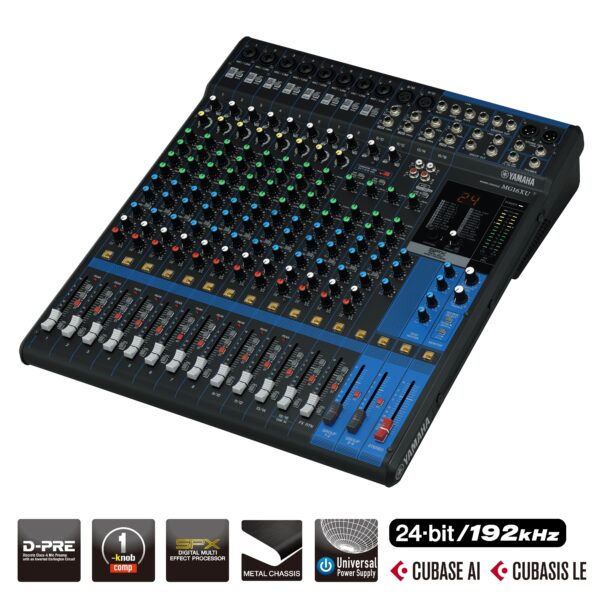
Yamaha MG16XU 16-Channel Analog Mixing Console with Effects & USB
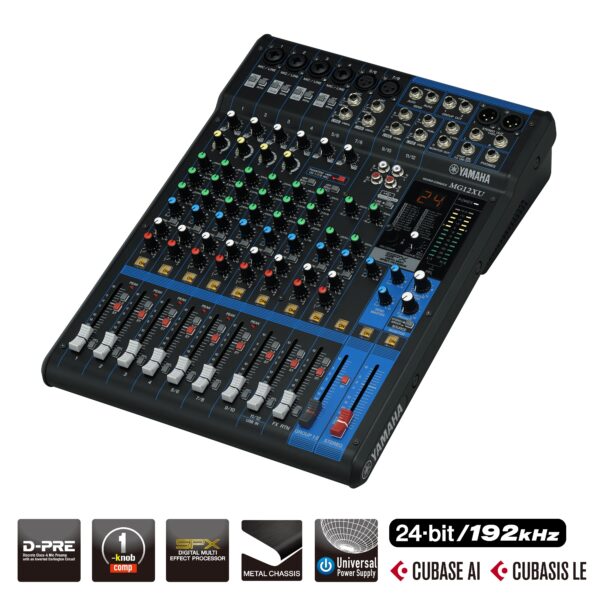
MRP₹64,80030% OFFYMS Price₹45,359Yamaha MG12XU 12-Channel Analog Mixing Console with Effects & USB
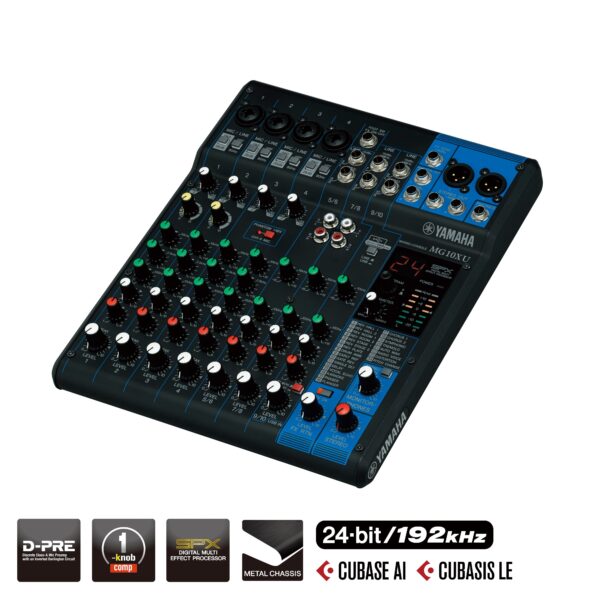
MRP₹44,10030% OFFYMS Price₹30,869Yamaha MG10XU 10-Channel Analog Mixing Console with Effects & USB
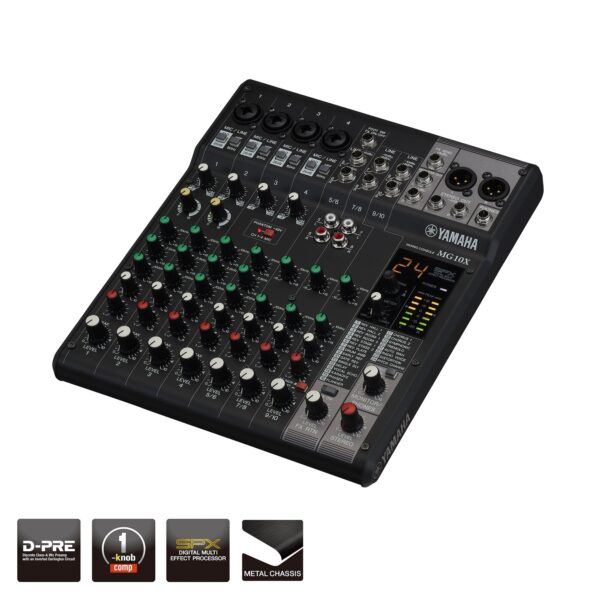
MRP₹27,00030% OFFYMS Price₹18,899Yamaha MG10X 10-Channel Analog Mixing Console with SPX Effects
MRP₹24,90030% OFFYMS Price₹17,429

Reviews
There are no reviews yet.