Product details
The One Most Studios Settle On
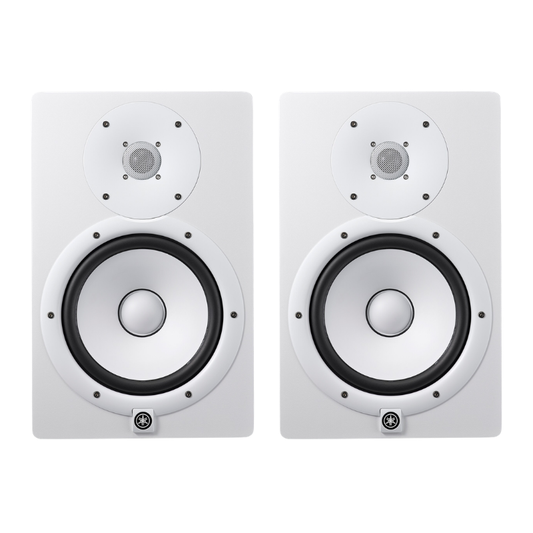
The HS7 sits in the middle of the range and is where most working project studios end up. A 6.5-inch woofer and 95 W of bi-amplification per speaker — 60 W low, 35 W high — take the response down to 43 Hz, low enough to hear what a bass line and a kick drum are actually doing without needing a subwoofer.
It keeps the same honest, unflattering voicing as the rest of the HS line. Nothing is hyped, so problems in a mix show up here rather than on someone else's system later.
At a Glance
What You Get
- Two independently powered speakers. Unlike the HS3 and HS4, where one cabinet drives the other, each HS7 has its own amplifier and its own mains lead — so you can place them as far apart as your room and cables allow.
- Bi-amplified 95 W per speaker — 60 W to the 6.5-inch woofer and 35 W to the 1-inch dome tweeter, crossing over at 2 kHz.
- Frequency response 43 Hz–30 kHz (−10 dB), 55 Hz–24 kHz (−3 dB) — a full 11 Hz lower than the HS5 and the point at which bass becomes genuinely readable.
- Balanced XLR and TRS inputs on each speaker — an audio interface or mixer is required, as there is no RCA or 3.5 mm socket.
- Room Control and High Trim switches on both cabinets — cut 2 or 4 dB below 500 Hz for wall or corner placement, and ±2 dB at high frequencies to suit the room.
- 210 × 332 × 284 mm and 8.2 kg per speaker — noticeably larger and heavier than an HS5, so check your desk or stands.
Before You Buy: Two Things That Catch People Out
1. Bigger is not automatically better in a small room
A 6.5-inch woofer needs space to work. In an untreated bedroom under roughly 10 square metres, the extra low end usually excites room modes and makes bass harder to judge, not easier. In that situation the HS5 pair is the better monitor and the cheaper one. Be honest about your room before you size up — we would rather you bought the right size than the bigger one.
2. You will need an audio interface
Balanced XLR and TRS inputs only — no RCA, no 3.5 mm. A laptop headphone output cannot drive these properly. Budget for an interface if you do not already own one. If you would rather plug a laptop straight in, the HS3 and HS4 pairs are built for that.
The Yamaha HS Range at YMS
Every HS studio monitor we stock. All are sold as pairs — only the HS8S subwoofer is a single unit.
| Model | Woofer | Amp power | Response (-10 dB) | Inputs | Amplification |
|---|---|---|---|---|---|
| HS3 | 3.5" | 26 W + 26 W | 70 Hz - 22 kHz | XLR/TRS, RCA, 3.5 mm | Left powered, right passive |
| HS4 | 4.5" | 26 W + 26 W | 60 Hz - 22 kHz | XLR/TRS, RCA, 3.5 mm | Left powered, right passive |
| HS5 | 5" | 70 W per speaker | 54 Hz - 30 kHz | XLR, TRS | Both speakers powered |
| HS7 | 6.5" | 95 W per speaker | 43 Hz - 30 kHz | XLR, TRS | Both speakers powered |
| HS8 | 8" | 120 W per speaker | 38 Hz - 30 kHz | XLR, TRS | Both speakers powered |
| HS8S | 8" subwoofer | 150 W | 22 Hz - 160 Hz | XLR, TRS | Subwoofer, sold singly |
FAQ
Q. How many speakers do I get?
Two — a complete stereo pair for the price shown. Each is a fully powered speaker with its own amplifier and mains lead.
Q. HS5 or HS7?
Room size, mostly. The HS7 reaches 43 Hz against the HS5's 54 Hz and has more headroom, which matters in a treated room of reasonable size or if you work with a lot of low end. In a small untreated room the HS5 is usually the better and cheaper answer.
Q. HS7 or HS8?
The HS8 goes 5 Hz lower and is louder, but each cabinet is 10.2 kg and 250 mm wide, and it wants a properly sized room and real stands. For most home and project studios the HS7 is the sweet spot; the HS8 is for larger rooms and heavier low-end work.
Q. Do I still need a subwoofer?
Usually not. At 43 Hz an HS7 pair covers everything except deep sub-bass. Add an HS8S only if you genuinely work in electronic music or film where content below 40 Hz matters — and only in a room that can support it.
Q. I only need one speaker as a replacement. Can you help?
Yes — we sell the HS range as pairs, but if you need a single unit to replace a damaged one or to add to an existing setup, contact us and we will source it for you.
Why Buy from YMS?
YMS For Music is an authorised Yamaha Premium Retailer. Every monitor is genuine Yamaha stock with full manufacturer warranty.
Monitors are worth hearing before you commit — come and listen in Bengaluru or Mangaluru. Tell us your room size and what you mix, and we will tell you honestly whether the HS7 is the right size or whether you should go up or down. Secure delivery across India.
Specifications
Overview
| Model | Yamaha HS7 |
|---|---|
| Type | 2-way bi-amplified powered studio monitors, bass-reflex |
| Packaging | Sold as a pair - two independently powered speakers |
| Finishes | Black or White - select above |
Drivers & Amplifier (each speaker)
| Woofer | 6.5 in cone |
|---|---|
| Tweeter | 1 in dome |
| Amplifier Power | 95 W total - LF 60 W, HF 35 W |
| Crossover | 2 kHz |
Performance
| Frequency Response (-10 dB) | 43 Hz - 30 kHz |
|---|---|
| Frequency Response (-3 dB) | 55 Hz - 24 kHz |
| Room Control | 0 / -2 / -4 dB under 500 Hz |
| High Trim | +/-2 dB at high frequencies |
Connections
| Inputs (each speaker) | XLR3-31 type (balanced), PHONE / TRS (balanced) |
|---|---|
| RCA or 3.5 mm | Not fitted - an audio interface or mixer is required |
General
| Dimensions each (W x H x D) | 210 x 332 x 284 mm |
|---|---|
| Net Weight | 8.2 kg each |
Price and quantity are for a pair. Both cabinets are independently powered, unlike the HS3 and HS4 where the left speaker drives a passive right. Single units can be supplied on request as replacements. Specifications from Yamaha official product data.
View specification source Opens in a new window.Videos
Similar products
-
Yamaha HS8 8" Powered Studio Monitors - Pair
Regular price Rs. 48,764.00 INRRegular priceRs. 66,800.00 INRSale price Rs. 48,764.00 INR -